Montana Dog Registration Information
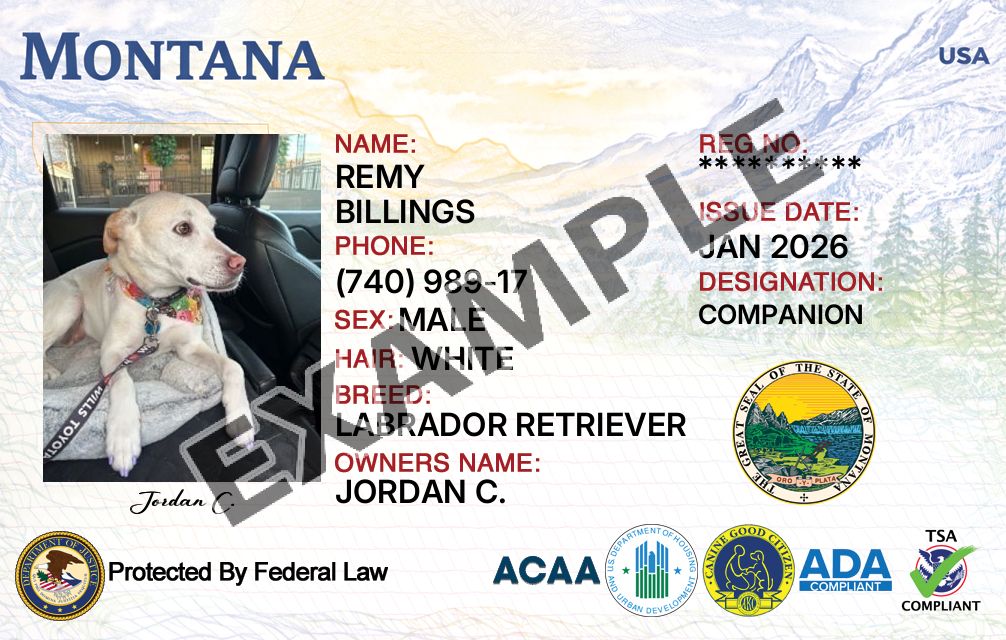
State Licensed, Service Dogs and Emotional Support Dogs in Montana
If you’re searching where do I register my dog in Montana for my service dog or emotional support dog, the most important thing to know is this: Montana generally does not have one single, statewide “service dog registration” or “ESA registration” office. In practice, what most people mean by “registering” is getting a dog license in Montana through the appropriate city, county, or animal control office where they live.
A local dog license (sometimes handled by animal control, a city clerk, a county health department, or a sheriff’s office) is different from your dog’s status as a service dog under disability law or an emotional support animal for housing purposes. This page explains how licensing works locally, what rabies rules typically require, and where to register a dog in Montana using examples of official Montana offices.
Where to Register or License Your Dog in Montana
Because licensing is commonly handled at the county or city level, the right place to contact depends on your address (city limits vs. county jurisdiction). Below are several example official offices in Montana that handle dog licensing, animal services, animal control, or rabies-related enforcement for their communities. If you don’t see your county/city listed, use the “How Dog Licensing Works Locally in Montana” section below to identify the correct office for your area.
Example Office: Missoula Animal Services (Missoula County / City of Missoula)
| Office name | Missoula Animal Services |
|---|---|
| Street address | 6700 Butler Creek Road |
| City / State / ZIP | Missoula, MT 59808 |
| Phone | 406-541-7387 |
| Not publicly listed on the licensing page | |
| Office hours | Monday–Friday: 12:00 PM–5:30 PM; Saturday: 12:00 PM–4:00 PM |
Note: Missoula’s local animal licensing information is also provided through Missoula Public Health. Licensing requirements commonly include proof of rabies vaccination for issuance of a tag.
Example Office: Missoula Public Health (Animal Licensing & Permits)
| Office name | Missoula Public Health |
|---|---|
| Street address | 301 W. Alder Street |
| City / State / ZIP | Missoula, MT 59802 |
| Phone | 406-258-4770 |
| Not publicly listed as a direct licensing email on the licensing page | |
| Office hours | Monday–Friday: 8:00 AM–5:00 PM |
Missoula’s animal licensing pages emphasize licensing as a visible “ticket home” and commonly require proof of rabies vaccination.
Example Office: Billings Animal Control (City of Billings)
| Office name | Billings Animal Control |
|---|---|
| Street address | 316 North 26th Street, 4th Floor |
| City / State / ZIP | Billings, MT 59101 |
| Phone | 406-657-8226 |
| Not publicly listed in the Animal Control contact snippet | |
| Office hours | Monday–Friday: 10:00 AM–6:00 PM (per city FAQ) |
Billings Animal Control is part of the Billings Police Department and focuses on enforcing city animal control laws, including local registration/licensing rules.
Example Office: Lewis and Clark County Sheriff’s Office (Animal Control / Dog Control District)
| Office name | Lewis and Clark County Sheriff’s Office — Animal Control |
|---|---|
| Dog license locations |
City-County Building: 316 N Park, Room 147 (Helena area) Lewis and Clark Humane Society: 2112 Custer Avenue |
| City / State | Helena area, MT |
| Phone | Not listed on the ordinance summary snippet |
| Not listed | |
| Office hours | Not listed |
The county’s ordinance summary notes licensing requirements inside the Dog Control District and references rabies vaccination rules for dogs 6 months or older.
Example Office: Great Falls Police Department (Animal Control)
| Office name | Great Falls Police Department — Animal Control |
|---|---|
| Street address | Not listed on the animal control page snippet |
| City / State | Great Falls, MT |
| Phone | 406-455-8492 |
| Not listed | |
| Office hours | Monday–Friday: 9:00 AM–5:00 PM (Animal Control Officers on duty) |
Great Falls animal control is handled by the police department and focuses on enforcement of local ordinances and response to animal complaints.
Overview of Dog Licensing in Montana
There isn’t one statewide “Montana dog registration” for every address
In Montana, dog licensing is typically created and enforced through local ordinances (city or county rules), not a single statewide licensing program. That is why people searching for an animal control dog license Montana often end up needing to contact a specific city animal control office, a county sheriff’s office (in areas where it provides animal control), or a local public health/animal services department.
Rabies vaccination rules are often local (but rabies prevention is strongly recommended)
Rabies prevention is a major reason many communities require licensing: licensing systems usually require proof of current rabies vaccination to issue a tag. However, Montana’s state animal-health guidance notes that there is no single statewide rabies vaccination requirement for pets, and that rabies vaccination requirements are commonly regulated by individual cities and counties. That local control is the same reason licensing varies across Montana communities.
What a “dog license in Montana” usually does (and does not do)
- Creates a record connecting your dog to you (owner name/address).
- Issues a visible tag (helpful if your dog is found).
- Encourages or requires rabies vaccination compliance.
- Funds local animal services (varies by jurisdiction).
- Turn a pet into a service dog.
- Grant public access rights for an ESA.
- Replace training, behavior standards, or handler responsibility.
- Prove disability status.
In other words, licensing is about local identification and public health/safety. Service dog and ESA rules come from different legal frameworks and have different requirements.
How Dog Licensing Works Locally in Montana
Step 1: Identify whether you live inside city limits
The biggest “fork in the road” for where to register a dog in Montana is whether your address is inside a municipality that requires licensing. Some cities require dogs (and sometimes cats) to be licensed, while a county may only require licensing in certain districts or may handle enforcement differently in rural areas.
Step 2: Find the correct local agency
Depending on your area, dog licensing and rabies enforcement may be handled by one of these:
- City Animal Control (often within a police department), especially in larger cities.
- County Animal Services or Public Health, sometimes operating or contracting shelter services.
- County Sheriff’s Office, particularly in counties where animal control is managed by the sheriff or a designated animal control officer.
- City Clerk / City Hall licensing counter (common in smaller municipalities).
If you’re unsure, call the city/county’s main line and ask: “Which office issues dog licenses and enforces rabies or animal control ordinances for my address?”
Step 3: Prepare your documents and pay the local fee
Most licensing offices will ask for proof of a current rabies vaccination (and may also ask spay/neuter information, depending on local rules). A local license fee may vary by:
- Whether your dog is spayed/neutered
- Your dog’s age (puppy vs adult)
- License term (annual vs multi-year)
- Senior or other discounts (varies by jurisdiction)
Some jurisdictions issue a tag immediately; others may mail it. Keep copies of your rabies certificate and your license record, especially if you travel between cities/counties with different rules.
What about rabies enforcement and quarantines?
Montana’s animal-health guidance explains that counties can be placed under quarantine when rabies is confirmed in certain animals, and that recommended actions after exposure can include vaccination boosters, observation, quarantine, or other steps. For day-to-day requirements, your city/county ordinance is what controls whether rabies vaccination is required for licensing and how animal bites/exposures are handled.
Service Dog Laws in Montana
A dog license is not service dog “registration”
Many people search for “register my service dog” because they want something official they can show. But legally, a service dog is defined by training and work/tasks performed for a person with a disability. A local dog license is still important (and often required), but it is not a substitute for service dog standards.
What makes a dog a service dog?
A service dog is generally understood as a dog that is individually trained to do work or perform tasks for a person with a disability. Examples of task work can include:
- Guiding a person who is blind
- Alerting to sounds for a person who is deaf/hard of hearing
- Interrupting or mitigating symptoms (such as certain psychiatric or neurological tasks)
- Mobility assistance (retrieving items, opening doors, bracing where appropriate)
The key point is trained tasks, not just comfort or presence. Your dog can be a service dog regardless of whether it wears a vest, has an ID card, or appears in an online registry.
Do you need a special tag, certificate, or registry?
There is no single Montana state “service dog license” that replaces local licensing. Focus first on local compliance: keep your dog properly licensed (where required) and follow your city/county animal control and rabies rules. Then ensure your service dog meets training, behavior, and handling expectations in public settings.
Emotional Support Animal Rules in Montana
ESAs are not the same as service dogs
An emotional support animal (ESA) provides comfort that can help with a person’s mental health symptoms, but an ESA is not trained to perform disability-related tasks in the way a service dog is. That difference matters because it affects where your animal is allowed and what rules apply.
What ESAs can help with (commonly housing-related)
In many situations, ESA considerations come up in housing. People seek documentation to request a reasonable accommodation with a landlord or housing provider. Even if your dog is an ESA, local rules about a dog license in Montana (city/county licensing) and local rabies vaccination requirements still apply.
What ESAs do not automatically get
- Public-access rights like a service dog (for example, entry into restaurants or retail where pets are not allowed).
- Exemption from local animal control ordinances (licensing, leash rules, nuisance rules, etc.).
- A single government-issued “ESA registration” that replaces local licensing.
Frequently Asked Questions
If you want, share your city and county in Montana (for example: “Billings, Yellowstone County” or “unincorporated Ravalli County”), and I can help you narrow down which official local office is most likely responsible for your dog license.
What You May Need
- rabies vaccination proof
- identification
- proof of residency
- licensing fee
Quick clarity: licensing vs. “registration”
If your goal is local compliance, focus on obtaining the correct local dog license in Montana for your address. If your goal is service dog or ESA status, focus on the correct legal framework (service dog task training vs. ESA housing documentation) while still following local animal control rules.
Register A Dog In Other Montana Counties
Select your county from the dropdown below to get started with your dog’s ID card. Requirements and license designs may vary by county, so choose your location to see the correct options and complete your pup’s registration.
- Beaverhead County Dog Registration
- Big Horn County Dog Registration
- Blaine County Dog Registration
- Broadwater County Dog Registration
- Carbon County Dog Registration
- Carter County Dog Registration
- Cascade County Dog Registration
- Chouteau County Dog Registration
- City of Anaconda County Dog Registration
- City of Butte County Dog Registration
- Custer County Dog Registration
- Daniels County Dog Registration
- Dawson County Dog Registration
- Deer Lodge County Dog Registration
- Fallon County Dog Registration
- Fergus County Dog Registration
- Flathead County Dog Registration
- Gallatin County Dog Registration
- Garfield County Dog Registration
- Glacier County Dog Registration
- Golden Valley County Dog Registration
- Granite County Dog Registration
- Hill County Dog Registration
- Jefferson County Dog Registration
- Judith Basin County Dog Registration
- Lake County Dog Registration
- Lewis and Clark County Dog Registration
- Liberty County Dog Registration
- Lincoln County Dog Registration
- Madison County Dog Registration
- McCone County Dog Registration
- Meagher County Dog Registration
- Mineral County Dog Registration
- Missoula County Dog Registration
- Musselshell County Dog Registration
- Park County Dog Registration
- Petroleum County Dog Registration
- Phillips County Dog Registration
- Pondera County Dog Registration
- Powder River County Dog Registration
- Powell County Dog Registration
- Prairie County Dog Registration
- Ravali County Dog Registration
- Richland County Dog Registration
- Roosevelt County Dog Registration
- Rosebud County Dog Registration
- Sanders County Dog Registration
- Sheridan County Dog Registration
- Silver Bow County Dog Registration
- Stillwater County Dog Registration
- Sweet Grass County Dog Registration
- Teton County Dog Registration
- Toole County Dog Registration
- Treasure County Dog Registration
- Valley County Dog Registration
- Wheatland County Dog Registration
- Wibaux County Dog Registration
- Yellowstone County Dog Registration